Personalisation-as-a-Service: What It Means for Corporate Gifting in 2026
Published 25 April 2026
What is Personalisation-as-a-Service? A Guide for Corporate Gifting
How on-demand infrastructure is changing the way businesses create and send branded merchandise.
Personalisation-as-a-Service (PaaS) is a model where a technology platform provides the complete backend infrastructure for businesses to customise products, manage complex orders, and deliver them directly to recipients. Instead of manually sourcing items and coordinating with printers, companies use a self-serve platform to control the entire corporate gifting workflow from a single dashboard.
For years, creating branded merchandise has been a fragmented and time-consuming process. It involved endless email chains with suppliers, confusing quotes, manual proofing of designs, and the logistical headache of collecting addresses and coordinating deliveries. A PaaS approach replaces this manual work with an integrated system, allowing teams to focus on the impact of their gifts rather than the administration behind them.
Key Takeaways
- PaaS Defined: It is a technology layer that provides the tools—a product catalogue, visual editor, and delivery logistics—for businesses to execute personalised gifting programmes on demand.
- Infrastructure vs. Service: A PaaS platform is the underlying infrastructure, much like cloud computing for websites. In contrast, a traditional supplier is a manual service provider.
- Core Components: The essential features of a gifting PaaS include a visual personalisation editor, multi-recipient checkout, production integration, and order management dashboards.
- Primary Benefits: Companies using a PaaS model gain speed, scalability, and control while significantly reducing the administrative overhead for HR, marketing, and operations teams.
In This Article
What Does 'Personalisation-as-a-Service' Actually Mean?
At its core, Personalisation-as-a-Service treats the ability to customise a physical product as a utility that can be accessed on demand through software. Instead of a business needing to build its own supply chain and production capabilities, it plugs into a PaaS platform that has already done the heavy lifting. This is analogous to how companies use Amazon Web Services (AWS) for computing power instead of building their own data centres.
A true PaaS for gifting is built on four distinct pillars that work together:
- A Curated Product Marketplace: The platform offers a pre-vetted catalogue of products—from notebooks and tumblers to apparel—that are confirmed to be suitable for various personalisation methods. This eliminates the sourcing and testing phase for businesses.
- A Visual Personalisation Engine: This is the user-facing tool where the magic happens. Teams can upload logos, add custom text, choose fonts and colours, and even input individual names for each item in an order. The engine generates a live preview, ensuring what you see is what you get.
- Integrated Production & Fulfilment: The software is directly connected to a production facility. When an order is placed, the designs and instructions are sent straight to the appropriate machines—be it a UV printer or a laser engraver—without manual intervention. The platform handles production, packing, and dispatch.
- Corporate Workflow & Logistics Management: This layer includes features specifically built for business needs, such as generating quotations for approval, handling delivery to hundreds of different addresses in a single checkout, scheduling deliveries for specific dates, and managing a central address book of recipients.
When these four pillars are combined, they create a powerful piece of personalisation infrastructure that any business can use, regardless of its size or technical expertise.
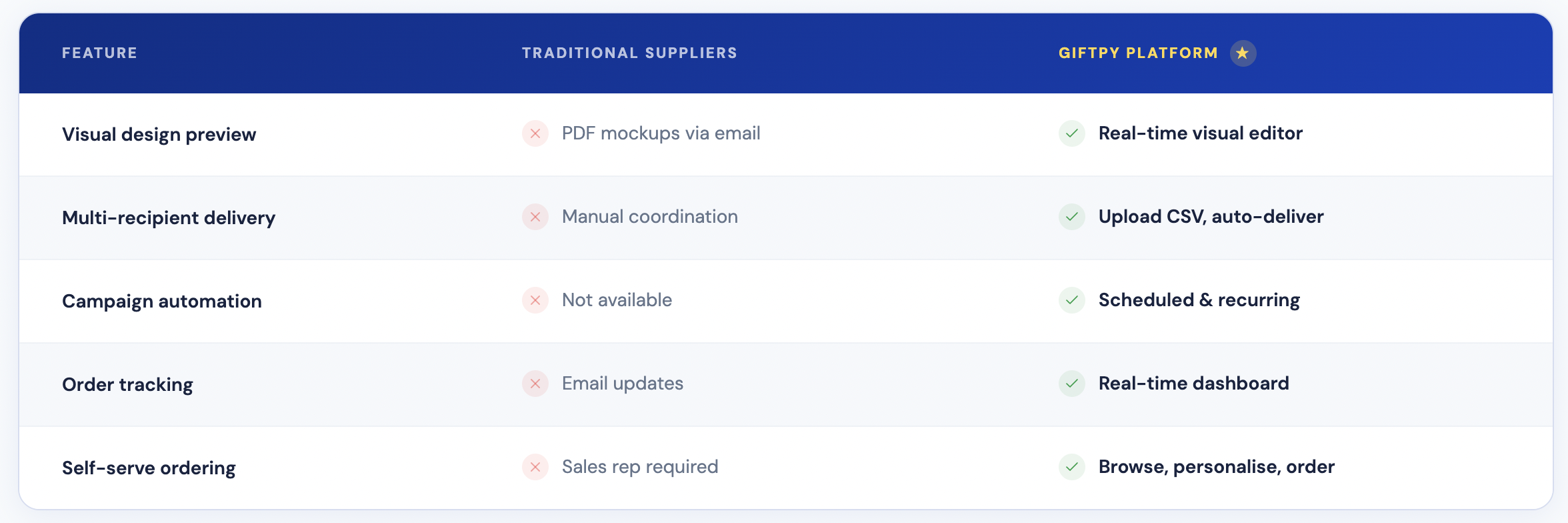
The Traditional Model vs. The PaaS Approach
The shift to a PaaS model represents a fundamental change in how corporate gifting is managed. The old way was defined by manual processes and communication bottlenecks, while the new way is about self-service and automation. Here’s a direct comparison of the workflows:
| Aspect | Traditional Gift Supplier | Personalisation-as-a-Service Platform |
|---|---|---|
| Workflow | Manual and conversational. Initiated via email or phone call. Multiple back-and-forth communications to confirm details. | Self-serve and automated. Users log in, design, and check out on a single platform. Real-time order tracking. |
| Design Process | Email a logo and instructions. Wait for a designer to create a PDF proof. Request revisions via email. | Use a live visual editor to place logos, add text, and see instant previews. No design skills required. |
| Quoting | Request a quote, wait for a salesperson to prepare it. Revisions require a new quote. | Instant, auto-generated quotations based on the items and customisations in your cart. |
| Recipient Management | Send a spreadsheet of names and addresses to be manually processed. High potential for human error. | Upload an Excel file of addresses, or use a saved address book. The platform validates and manages recipient data. |
| Per-Item Personalisation | Difficult and costly. Often requires significant manual setup for printing individual names on each item. | Built-in functionality. Simply provide a list of names and the platform handles the individual printing for each unit automatically. |
| Lead Time | Variable and often longer due to communication delays and manual setup. | Shorter and more predictable, as automation removes many of the administrative delays. Stocked items can ship in 3-5 business days. |
What Kinds of Personalisation Are Possible with a PaaS Platform?
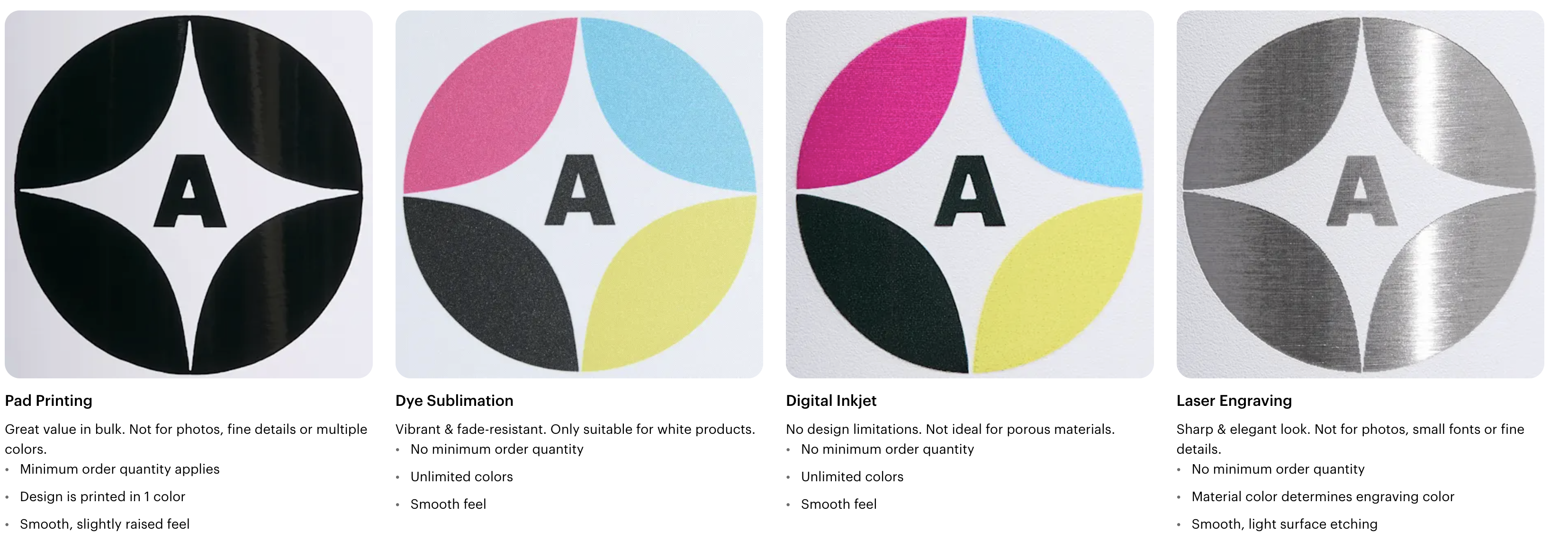
The power of a personalisation platform lies in its integrated production capabilities. Because the software is built by teams who understand manufacturing, it can offer a wide array of high-quality customisation methods. This gives businesses the flexibility to choose the perfect look and feel for their branded merchandise.
Common techniques available through a modern personalisation infrastructure include:
- UV Printing: A digital printing method that uses ultraviolet lights to cure ink instantly on a surface. It’s ideal for creating vibrant, full-colour logos and designs on hard goods like notebooks, power banks, and water bottles.
- Laser Engraving: This process uses a laser beam to precisely etch a design into a material's surface. It creates a subtle, premium, and permanent finish, perfect for high-end client gifts on metal pens, wooden boxes, or glass awards.
- Direct to Garment (DTG): An inkjet technology that prints high-resolution, full-colour images directly onto cotton fabrics. It’s the go-to method for detailed designs on t-shirts and tote bags, offering a soft feel without the thickness of traditional prints.
- DTF (Direct to Film) Printing: A versatile technique where designs are printed onto a special film and then transferred to fabric using heat. It works well on a wide variety of materials, including polyester and blends, making it suitable for activewear and bags.
- UV DTF Printing: This combines the versatility of DTF with the durability of UV-cured ink. It creates a 'sticker-like' transfer that can be applied to irregular or hard-to-print surfaces, offering incredible flexibility for complex objects.
- Sublimation: A process where heat turns ink into a gas that bonds with polyester fabric or a special coating. It produces brilliant, permanent colours that won’t crack or fade, ideal for all-over prints on lanyards, mugs, and mousepads.
Who Benefits Most from a Gifting PaaS?
A PaaS model democratises access to high-quality personalisation. It is particularly valuable for teams that manage recurring gifting programmes but lack the in-house resources for design and procurement.
Corporate HR & People Teams
For sending consistent and high-quality employee onboarding kits, celebrating work anniversaries, and acknowledging team milestones. A PaaS removes the administrative burden of collecting addresses and managing individual deliveries.
Marketing & Event Managers
For creating event swag, branded merchandise for campaigns, and high-impact client appreciation gifts. The self-serve editor allows for rapid execution without relying on a central design team, speeding up campaign launches.
SMEs and Startups
For producing professional company swag and team gifts without needing to meet high minimum order quantities. A platform model makes sophisticated personalisation accessible and affordable, even for small batches.
Gifting Marketplaces
These businesses can use a PaaS platform as their backend personalisation infrastructure. It allows them to offer customised products to their own customers without investing millions in building their own production facilities and software.
Key Features to Look for in a Personalisation Platform
Not all platforms are created equal. When evaluating a Personalisation-as-a-Service provider for your business, there are several critical features to look for that separate a basic tool from a true piece of corporate infrastructure.
- An Intuitive Visual Editor: The editor should be simple to use, provide a live preview of your design, and critically, support per-recipient name personalisation. This allows you to print a different name on every single item in a bulk order automatically.
- Multi-Recipient Checkout: This is a non-negotiable for corporate use. The platform must allow you to ship items to hundreds of different addresses within a single transaction, saving hours of manual coordination.
- Scheduled Delivery: The ability to place an order now but schedule delivery for a future date is essential for planning ahead for holidays, birthdays, and company events.
- Automated Quotation Generation: To fit into corporate procurement workflows, the platform should allow you to generate a formal quotation directly from your shopping cart for internal approval processes.
- Address Book & Contact Management: For recurring gifting, a system to securely save and manage recipient details is a massive time-saver and reduces the risk of data entry errors.
- Transparent Inventory Model: The platform should be clear about lead times for in-stock items versus those produced on-demand, allowing you to plan your timelines accurately.
Frequently Asked Questions
What is the main difference between a PaaS and a regular corporate gift supplier?
A PaaS provides a self-serve technology platform for you to design and manage orders, while a supplier is a service that manually sources and brands items for you. PaaS is about providing infrastructure; suppliers are about manual procurement. This means you have more control and can automate complex orders directly.
Do I need design skills to use a Personalisation-as-a-Service platform?
No. A key feature of a PaaS like Giftpy is a user-friendly visual editor. You can typically upload a logo, add text with different fonts and colours, and see a live preview without needing any specialised design software or skills.
Is PaaS suitable for small orders?
Yes, many PaaS platforms are designed to handle both small and large orders flexibly. Because the process is automated, it can be cost-effective even for smaller batches, unlike traditional suppliers who often require large minimum order quantities to be viable.
How does a PaaS platform handle production?
The platform is directly integrated with production facilities. When you place an order, the design and recipient data are sent directly to the machinery—like UV printers or laser engravers—for production and then dispatched, all managed through the platform's backend.
Ready to Build Your Gifting Programme on a Modern Platform?
Explore how a Personalisation-as-a-Service platform can automate your corporate gifting workflows from design to delivery.
Explore GiftPy's Platform